Products
Demand Response
Generators
Most commercial and industrial facilities treat on-site generation as insurance — equipment that sits idle until the grid fails. Demand response changes that math. By reducing your draw from the grid during peak periods, you earn credits from your utility while the asset you already needed for resilience starts paying for itself.
White Harvest Energy supplies, installs and services the generation equipment that makes participation possible, for all types of facilities.
What demand response actually asks of you
During a peak period or a grid emergency, your utility asks participating customers to cut load. You can do that by shedding equipment — or by running your own generation and dropping off the grid for the duration of the event. The second option is usually the easier one, because nothing in your operation has to change.
Events are scheduled and notified in advance, typically a handful of times per season. Your facility keeps running normally. The only difference is where the power comes from.
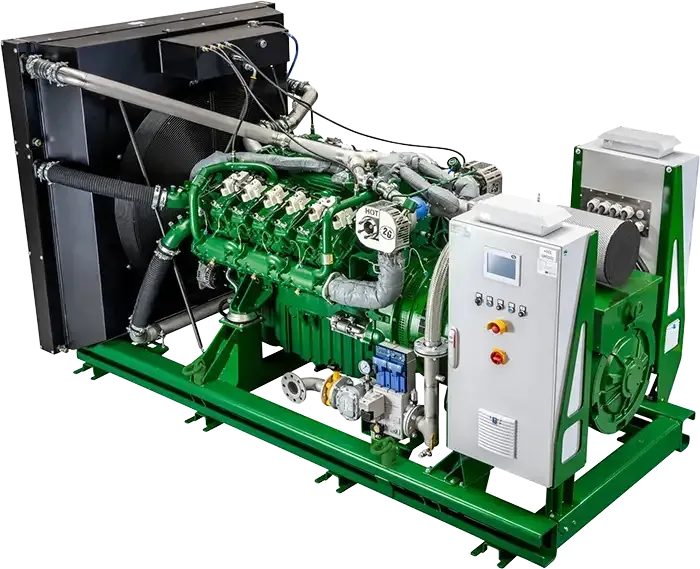
Purpose-built for demand response: the DR aura 412
Most generators sold into demand response are standby sets asked to do a job they weren’t designed for. The DR aura 412 was built for it.
It’s a V12, 26.8-liter natural gas engine producing 620 kW at 480 V, 60 Hz. It runs on natural gas or propane with dynamic switching between fuels, so a pipeline interruption doesn’t end your event participation. It accepts a 100 % load step in 10-15 seconds, which matters when you need to transfer a live facility cleanly rather than ride through a blip.
Four ratings, one platform
Demand response isn’t one duty cycle. The DR aura 412 is rated across all four operating modes defined in ISO 8528-1, so the unit is matched to how you actually intend to run it:
| Rating | Natural gas | Propane | Annual hours | Typical use |
|---|---|---|---|---|
| ESP — Emergency Standby | 620 kW | 435 kW | Up to 200 | Hospitals, data centres, safety-critical industry |
| LTP — Limited Time Power | 580 kW | 405 kW | Up to 500 | Grid support, peak shaving, commerce and industry |
| PRP — Prime Rated Power | 530 kW | 370 kW | Continuous, variable load | Peak shaving and demand response |
| COP — Continuous Power | 470 kW | 350 kW | 24/7 base load | Off-grid sites, continuous industrial loads |
If your interest is purely event participation a few times a season, ESP or LTP is the fit. If you intend to run against demand charges month after month, PRP is the rating that supports it.
Emissions and permitting
Demand response runs during peak periods — hot summer afternoons, exactly when air quality is most scrutinized. That makes emissions the deciding factor in whether a project gets permitted at all.
With its catalytic converter, the DR aura 412 is rated below 0.05 g/bhp-hr NOx. That is roughly an order of magnitude below what a conventional lean-burn gas engine produces without aftertreatment, and it is what makes extended run hours practical in ozone-sensitive areas rather than a permitting fight.
We work through the air permitting path with you before equipment is specified, not after.
Smaller sites and conventional generation
Not every demand response participant needs half a megawatt. With Peak Rewards opening at 50 kW of demand, a wide range of commercial facilities qualify.
Alongside the DR aura 412 we supply gaseous generators from 24 kW to 800 kW and diesel generators from 31 kW to 800 kW, in standby and prime ratings across 120/240 V single phase and 208 V through 600 V three phase. Where an existing standby set is already installed, we can assess whether it’s suitable for demand response duty before you commit to a program.
Is demand response right for your facility?
It usually is if you:
- Carry 50 kW or more of billed demand
- Already own standby generation, or need it regardless
- Run a facility where unplanned downtime is expensive
- Operate in a territory with utility demand response programs
Frequently asked questions
Does my facility go dark during an event?
No. You transfer to on-site generation and keep operating. Properly configured, the transition is not noticeable inside the building.
How often are events called?
A limited number per season, with advance notification.
Can my existing standby generator participate?
Sometimes. It depends on its rating, emissions certification and permitted run hours. Many standby engines are certified for emergency use only and cannot legally run for economic dispatch. We’ll tell you which category yours falls into.
What about propane?
The DR aura 412 runs on either fuel and switches dynamically, which is worth having where gas supply is interruptible.